
spinw.addaniso method#
Syntax#
addaniso(obj, matrixIdx, {atomTypeIdx}, {atomIdx})
Description#
addaniso(obj, matrixIdx, {atomTypeIdx}, {atomIdx}) assigns the
\([3\times 3]\) matrix selected by matrixIdx (using either the matrix
label or matrix index) to the magnetic sites selected by atomTypeIdx
that can contain a name of an atom or its atom index (see spinw.atom).
If atomTypeIdx is not defined, anisotropy will be assigned to all
magnetic atoms.
Examples#
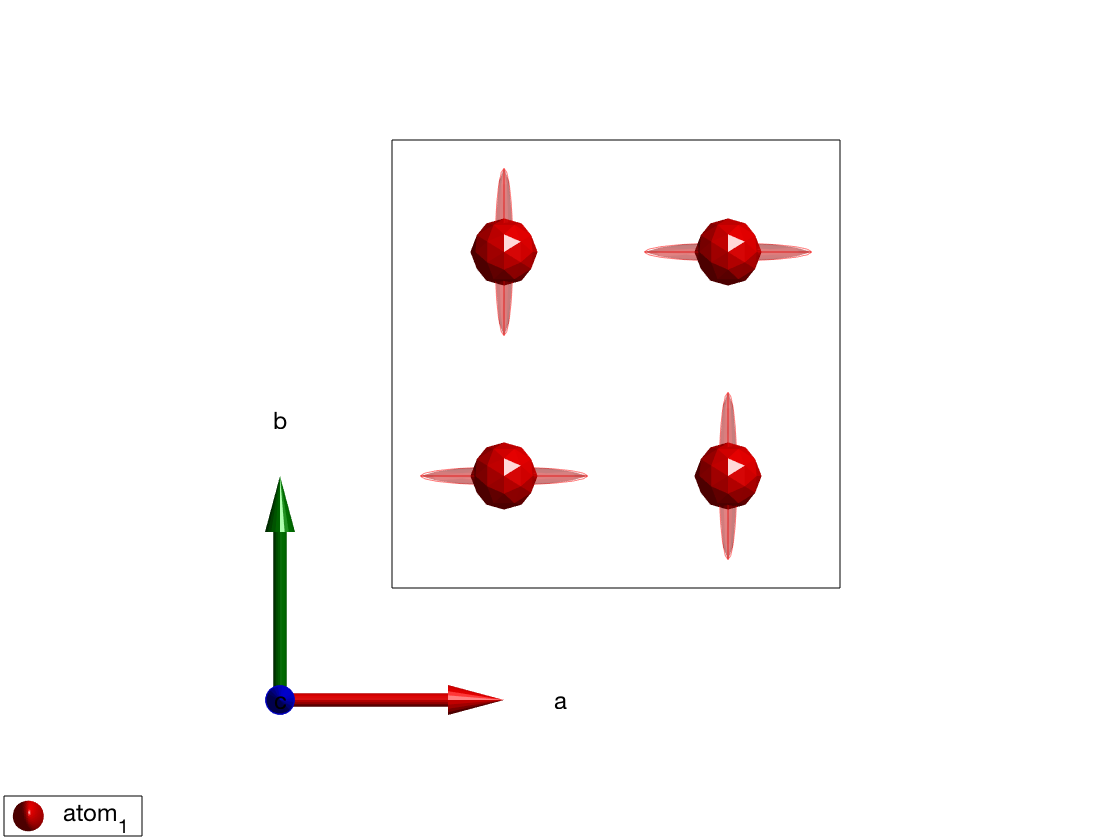
To show the effect of a fourfold axis on anisotropy, we add \(A_1\) easy-axis anisotropy to atoms at \((1/4,1/4,1/2)\) and plot the result. The 3D plot shows anistropy using ellipsoid around the magnetic atoms.
cryst = spinw
cryst.genlattice('lat_const',[4 4 3],'spgr','P 4')
cryst.addatom('r',[1/4 1/4 1/2],'S',1)
cryst.addmatrix('label','A1','value',diag([-0.1 0 0]))
cryst.gencoupling
cryst.addaniso('A1')
plot(cryst)
Input arguments#
objspinw object.
Name-Value Pair Arguments#
matrixIdxEither an integer, that selects the matrix according to
obj.matrix.mat(:,:,matrixIdx), or a string identical to one of the previously defined matrix labels, stored inobj.matrix.label.atomTypeIdxString or cell of strings that select magnetic atoms by their label. Also can be a vector that contains integers, the index of the magnetic atoms in
obj.unit_cell, with all symmetry equivalent atoms. Maximum value is \(n_{atom}\), if undefined anisotropy is assigned to all magnetic atoms. Optional.atomIdxA vector that contains indices selecting some of the symmetry equivalent atoms. Maximum value is the number of symmetry equivalent atoms generated corresponding to
atomTypeIdxsite. If crystal symmetry is not 0,atomIdxis not allowed, since the anisotropy matrix for equivalent atoms will be calculated using the symmetry operators of the space group. Optional.
Output Arguments#
The function adds extra entries in the obj.single_ion.aniso field of the
obj spinw object.
See Also#
spinw, spinw.single_ion, spinw.addcoupling, spinw.addg and spinw.addmatrix